HUNTERSVILLE, N.C. — Walking the trails of Latta Nature Preserve in full fall color, Mecklenburg County Commissioner Elaine Powell can’t help but smile. She considers the park, alongside Mountain Island Lake, the perfect example of what county-owned land should be, a shared space for recreation, a natural buffer protecting the source of local drinking water and one of the few remaining areas of the county she can be sure won’t soon be covered in pavement.
Over the past 15 years, Powell said she knew the county was growing and changing, but it wasn’t until she commissioned a series of maps from the county’s GIS specialists. Comparing the 2008 map to 2024, the evidence was undeniable. Mecklenburg County is quickly losing its green space.
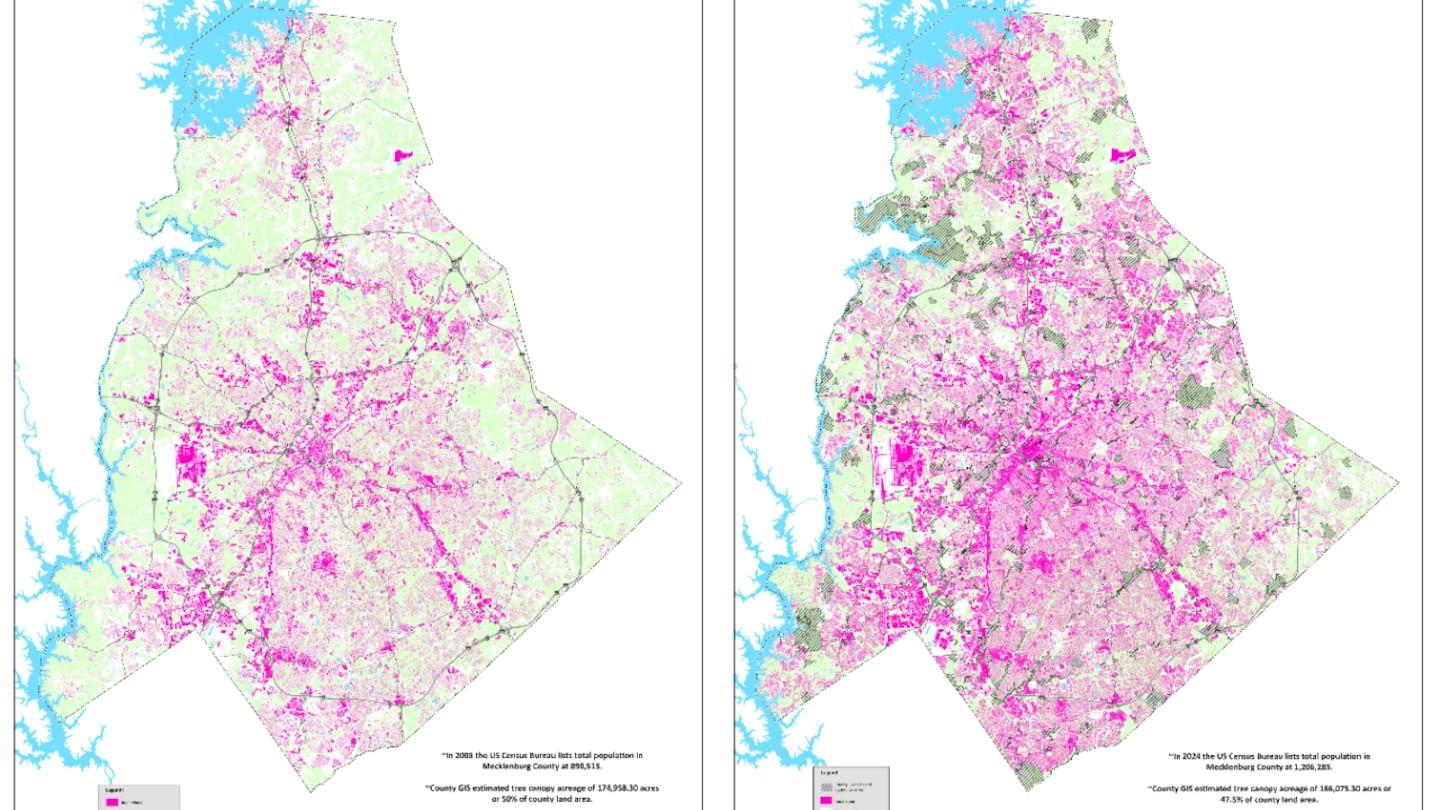
“I don’t know if I was surprised but I’m thankful that it really is a visual impact that people are starting to pay attention to,” she said. “It really is a powerful tool.”
In 2008, the maps show just 6% of the county’s land is paved over. In 2024 that becomes 24%, a quadrupling of impervious surfaces that Powell fears will have serious impacts on quality of life in Mecklenburg County if this trend keeps up.
“When you lose the natural space, the natural system, you compromise air quality, you compromise water quality,” she said.
The development is downstream of the county’s massive population growth. In 2008 there were about 890,000 people in the county. By 2024, there were more than 1.2 million. The Charlotte Business Alliance estimates 157 people are coming to metro area every day and all those people need to go somewhere.
“You can’t avoid the people coming here but how do we do it in a better way?” Powell said.
She believes sacrificing too much green space or the limited amount of forest the county has left would be a mistake.
Trees, parks and gardens can provide shade and help combat the urban heat island effect, they can help prevent pollution from stormwater runoff, filter pollutants from the air and help prevent localized flooding. They help the county both adapt to and combat climate change.
“It’s not like you can magically get that back,” Powell said.
Alex Smith, the urban forest manager for TreesCharlotte understands what it takes to restore tree canopy once it’s lost. In a neighborhood that lost most of its canopy during Hurricane Hugo and couldn’t reinvest and replant, the canopy was down to about 5%.
Volunteers put in 120 new trees on that land last year, but it will likely take about 20 years before the canopy is restored. Smith said that’s a worthy effort, but it’s nowhere near as effective as preserving the canopy that’s already there.
“If we go out and we knock down 10 acres worth of trees, we can roughly estimate that’s 300-400 trees that we’ve taken down that were mature,” he said. “When we’re putting up townhomes and we’re putting a few trees along the street, that’s not really replacing canopy.”
He said he understands development is part of the reality of living in a rapidly growing area, but he’d like to see more incentives to develop land that’s already paved rather than encouraging more sprawl and encroaching on greenspace.
“Finding ground that’s already in some state of use or nonuse might be a better solution,” he said.
Powell agrees, but she believes that won’t happen without policy to back it up. She’s hoping the maps she created can help create a sense of urgency for the county to purchase environmentally important land for preservation, especially along the Catawba its lakes.
She fears, if the county doesn’t act now, in a few years, there won’t be much land left to preserve and Mecklenburg County will have lost something it can’t replace.
“If we don’t protect these natural spaces, no one will want to live here in 20 years,” she said.
VIDEO: Advocates say transit plan will help clean up environment

©2025 Cox Media Group

/cloudfront-us-east-1.images.arcpublishing.com/cmg/LH3JSJEF3VBLRJLJQESEAG34AM.png)


